
Why Looking Successful Can Keep You Broke
The difference between appearing successful and building lasting financial strength.
A lot of people are not trying to build wealth. They are trying to look like they already have it. That is a very different goal, and it leads to very different behavior. Once you start spending money to create the appearance of success, your financial life starts drifting in the wrong direction. The car gets nicer than it needs to be. The house gets bigger than the math really supports. The upgrades keep coming. The labels matter more. The whole thing becomes one long attempt to say, “I’m doing well,” whether the balance sheet agrees or not.
That is the trap. Looking successful and becoming financially strong are not the same project. In fact, they often work against each other. One burns cash to send a signal. The other keeps cash, invests cash, protects cash, and turns it into flexibility later. One is built around being seen. The other is built around being secure. People confuse those all the time, then wonder why a high income still feels strangely fragile.
This is part of the old Millionaire Next Door point that still holds up. It is a short, easy book, one of my favorites, and still one of the best places to start if you want a clearer picture of how wealth is actually built. A lot of real wealth looks much more ordinary than people expect, and the people who are truly strong financially are often not the ones putting on the biggest show.
That matters because modern life is full of signals. People signal status with cars, neighborhoods, schools, watches, vacations, renovations, and brands. None of those things are automatically bad. The problem is what happens when the signal becomes the goal. Once that happens, money stops being a tool and starts becoming stage design. You are no longer asking, “What strengthens our life?” You are asking, “What makes us look like we have made it?” That is how people end up with expensive lives and thin margins at the same time.
Original image source (review before reuse)
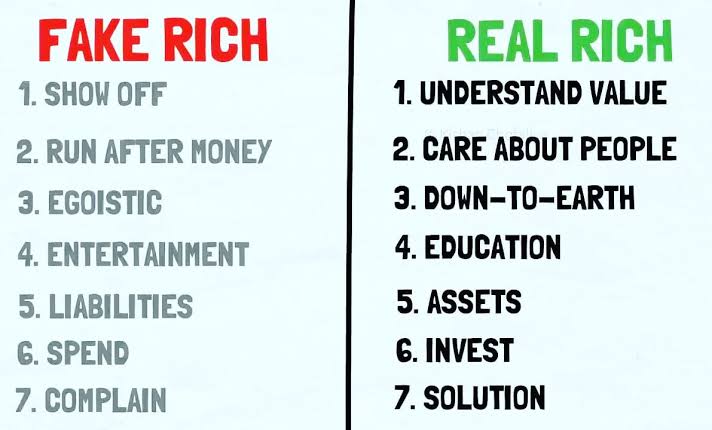
A good friend of mine recently referred to these kinds of people as “finance bros.” I had not really heard that term before, but it fits. Not because everyone in finance is like that, obviously. But because the type is real. The guy with the image, the vibe, the watch, the lease, the curated confidence, and just enough visible success to make you assume the money must be solid underneath. Sometimes it is. A lot of the time, it is mostly branding. The term is widely used now for exactly that kind of image-heavy, status-conscious performance.
And that is why looking successful can keep you broke. Not always broke in the literal sense. Sometimes broke in the deeper sense. Broke on margin. Broke on flexibility. Broke on peace. Broke in the sense that one layoff, one medical bill, one major repair, or one bad year suddenly becomes a crisis because so much of the income is already spoken for. The appearance is polished. The structure underneath is weak.
A lot of this comes down to fear. People do not want to look ordinary. They do not want the older car, the plain house, the unremarkable clothes, the vacation that was restful instead of impressive. They do not want to feel like the least flashy person in the room. That fear sounds small, but it gets expensive fast. It pushes people into bad financial decisions for the sake of good optics. It teaches them to spend for approval that usually fades in ten seconds anyway. Other people notice your stuff briefly, then go back to thinking about themselves. You are the one left with the payment.
That is also why income by itself can be deceptive. A big paycheck can fund two completely different lives. One person uses it to buy symbols. The other uses it to buy freedom. One builds a lifestyle that has to keep being fed. The other builds savings, investments, and room to breathe. One looks rich now. The other gets stronger over time. Those lives can look similar for a little while from the outside, but underneath they are moving in opposite directions.
This is where a lot of financial advice misses the point. People act like the main question is whether you can technically afford something. But that is often too shallow. The better question is what the purchase is doing to your life. Is it adding joy, usefulness, and genuine value? Or is it mostly helping you perform success for other people? Once you start asking that question honestly, a lot of spending starts to look less like enjoyment and more like insecurity with a price tag.
And at some point, this stops being just a math issue and becomes a moral one. We are not taking any of this with us. Scripture says it plainly, “we brought nothing into the world, and we can take nothing out of it”. Even if you are not making a specifically Christian argument, that basic truth still lands. If none of this can be carried out in the end, then building your life around flaunting it is one of the emptiest things you can do with money.
That is why hoarding and showing off both miss the point. One clutches money like it is life itself. The other spends money trying to turn it into identity. Neither one understands what money is for. Money is a tool. It can protect a family, create breathing room, solve problems, and yes, be enjoyed. But one of the best things it can do is help you do actual good. There is a kind of joy that comes from being able to help someone, give generously, or carry somebody else’s burden that no status purchase can really compete with. Research on prosocial spending points in that direction too, even if it is not a mechanical formula.
None of this means you have to dress badly, drive a junk car, or turn frugality into a personality. That misses the point too. The goal is not to look poor. The goal is to stop lighting money on fire so strangers will assume you are important. There is a big difference between enjoying nice things and needing nice things to reassure yourself that you are winning.
Real wealth is quieter than that. It is margin. It is optionality. It is being able to handle bad news without panic. It is having savings that actually exist, investments that are actually growing, and a life that is not one oversized payment away from stress. It is being able to say no. It is being harder to control because you are not financially cornered. And beyond that, it is being able to open your hand. To give. To help. To use money as a servant rather than a costume.
So yes, looking successful can keep you broke, because image is hungry. It always wants one more upgrade, one more signal, one more way to prove you belong. Actual wealth is different. It does not need to show off every five minutes. It makes your life stronger, and in the best cases, it makes you more useful to other people too. That is the choice underneath all of this. You can buy the appearance of wealth, or you can build the real thing. Those are not the same, and if you keep confusing them, you can spend years looking successful while staying financially weak.